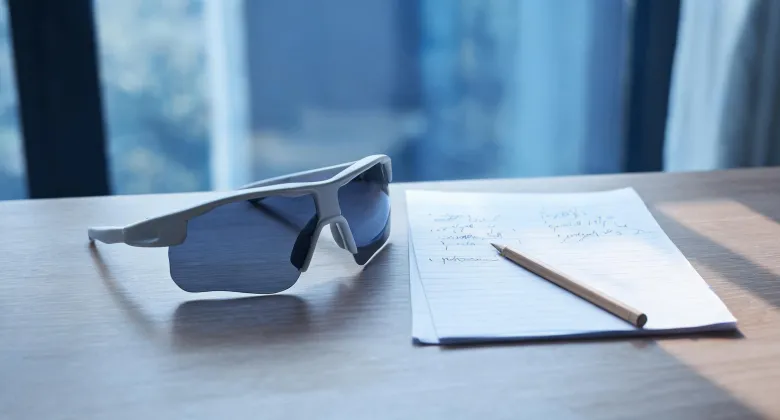
In March 2018, I approved a $2,300 mold fee for 120 pairs of cycling sunglasses. I was sure I'd found a shortcut. Six weeks later, the shipment arrived with lenses that didn't sit flush in the frames, and I learned that sourcing isn't a single decision—it's a sequence of decisions that change based on where you sit in the supply chain.
Over the last seven years, my team has placed wholesale cycling sunglasses orders at all three scales I'll describe below, and we've made at least one expensive mistake in each. What follows isn't a universal recommendation. There isn't one. Your right answer depends on three variables: your first order quantity, whether you need prescription lenses, and how much design customization you're actually asking for.
The Three Sourcing Scenarios (And Why They Don't Overlap)
My team has gotten this wrong in every direction. The person ordering 100 pairs gets pushed into a factory that doesn't want the business. The person ordering 5,000 pairs pays an agent markup they didn't need. The person who needs prescription lenses gets a \"yes, we can do that\" from a factory that genuinely cannot.
Here's the split I use now:
- Scenario 1: Test orders (50–300 pairs), standard frames. You need speed and low commitment more than unit price.
- Scenario 2: OEM/ODM custom orders (500–5,000 pairs). You need a real factory, plus a quality process to go with it.
- Scenario 3: Bulk wholesale (5,000+ pairs) or prescription cycling sunglasses. You need technical depth, not just capacity.
Each one has a different failure mode. I've hit all three.
Scenario 1: Small Test Orders (50–300 Pairs)
The counterintuitive advice: don't go straight to the factory
I ignored this in 2018 and paid for it. Most cycling sunglasses factories won't quote below 300–500 pieces per colorway, and if they do, they'll add a tooling fee that makes the per-unit cost higher than buying from a distributor. The $2,300 I paid in mold fees for 120 units worked out to a $19 premium per pair before the pair cost a dollar. That's not a sourcing win—that's a tuition payment.
Unless your test order is 500+ pieces, work with an importer, a trading company, or a factory's in-stock/closeout channel. You'll pay 15–30% more per unit than a 5,000-piece buyer would. That markup is fine. It's the price of not committing capital before you've confirmed your market.
What to actually check at this stage
- Lens sourcing, not frame sourcing. Ask which lens supplier they use. If they can't name one, walk.
- Stock colorways. Custom colors at this volume mean a minimum dye lot, usually 300+ per color. Don't ask. Seriously.
- UV claim in writing. Every pair shipped into the US should meet ANSI Z80.3. The FDA impact-resistance rule (21 CFR 801.410) applies to all sunglasses sold as such—verify the current text at fda.gov before finalizing any packaging claims.
If a vendor at this tier offers full OEM customization—custom mold, custom logo, custom packaging—be careful. Either they're an agent marking up a factory that will still reject you, or they're a factory that's about to charge you a development fee for a 50-piece order. Both will hurt.
Scenario 2: OEM/ODM Orders (500–5,000 Pairs)
Now you actually want the manufacturer
At this volume, direct relationships with a cycling sunglasses manufacturer start to make sense. But the failure mode shifts from \"you overpaid\" to \"you approved something you couldn't evaluate.\"
I'm not a lens engineer. I can't evaluate optical clarity, prismatic deviation, or coating adhesion by holding a sample. What I can do is set up a process so someone who can—a third-party test lab—checks the production run before it leaves. In September 2022, I paid $400 for a third-party optical inspection on a 2,400-pair order. That sounds like overhead until you compare it to the cost of a recall or a chargeback.
I've been guilty of skipping this on smaller runs, and it's come back on me. Twice.
The process gap I didn't fix until 2023
For years, we approved samples by \"looks good.\" That's not a process. A color deviation on a September 2022 production run—the frame color was two shades off from the approved sample—cost us a full rework cycle and about three weeks of delay. Not huge money, but the customer relationship took longer to repair than the order did.
The fix was boring: a written sample approval sheet with photos under three lighting conditions, a Pantone reference, and a signature line. We've used it on every order since. If I'd had this in 2021, I would have saved a lot of \"I thought you approved this\" emails.
Where buyers get overconfident
At this tier, it's tempting to ask for everything—custom frame, custom lens tint, custom hinge, custom packaging, and prescription-ready—from one factory. I have mixed feelings about one-stop sourcing. On one hand, it simplifies coordination. On the other, a factory that's excellent at frame molding is often mediocre at lens tinting, and I've watched \"we do it all\" turn into \"we do frames well and outsource everything else at a markup.\"
Ask the manufacturer directly: which steps happen in your building, and which are subcontracted? The answers will tell you where to focus your QC.
Scenario 3: Bulk Wholesale (5,000+ Pairs) or Prescription Cycling Sunglasses
The prescription question is where most buyers should slow down
Prescription cycling sunglasses are not a volume problem. They're a technical problem. Wrap frames (usually 8-base curvature) are difficult to glaze directly, so most factories offer either a prescription insert behind the shield or a flatter frame that accepts standard lenses. Both options have trade-offs:
- Inserts add weight and can fog more, but they let you keep a true wrap shape.
- Directly glazed wrap lenses require high-wrap lab capability, and not every lab has it.
I've never fully understood why prescription pricing varies so wildly between suppliers—quotes I've received for the same insert design have ranged from $18 to $90 per pair. My best guess is it comes down to lab capacity and whether they're actually doing the glazing in-house.
My 2021 mistake
I sent a standard sunglass order to a factory that assured me they could \"handle prescription before shipment.\" What they meant was that they'd send frames to a partner lab. The partner lab didn't have the correct PD measurement on file for 37 of the 400 pairs, so those frames went back out for rework. That mistake cost roughly $1,100 in rework and a three-week delay, and it taught me a rule I still use: if a cycling sunglasses factory says \"yes, we can do prescription,\" ask them which lab, what their PD tolerances are, and whether they can show a sample prescription build before you commit to production volume.
This gets into optometry territory, which isn't my expertise. I'd recommend consulting an optician or your own lab partner on the actual lens specifications before you approve anything.
Where the volume actually helps
Above 5,000 pairs, the biggest levers aren't unit price. They're things like consolidated lens purchasing, dedicated production slots, and the ability to negotiate payment terms. I've found that asking for a dedicated QC contact at this scale is worth more than a 3% price cut, though both are worth asking for.
How to Figure Out Which Scenario You're In
Answer these in order:
- Do you need prescription lenses? If yes, you're in Scenario 3 regardless of volume. The technical requirements dominate everything else.
- Is your first order under 300 pairs per style? If yes, you're in Scenario 1. Don't fight the MOQ—work around it.
- Are you customizing the frame, lens, or packaging? If yes and you're above 500 pairs, you're in Scenario 2.
- Are you reordering a proven SKU at 5,000+ pairs? If yes, you're in Scenario 3 whether or not you're buying prescription.
If you're between two scenarios—say, a 400-pair custom order—the safe move is to treat it as the higher scenario and set up the QC process from Scenario 2. The process overhead is smaller than you think, and it's cheaper than discovering quality issues after the fact.
One more thing: the \"cheapest sourcing solution\" isn't a stable category. The importer that beats everyone on 100 pairs will lose to a factory at 2,000 pairs, and both will lose to a direct-ship bulk arrangement at 10,000. If someone tells you they're the low-cost option at every volume, they're telling you something about how they sell, not how they source.
\"Total sourcing cost = unit price + tooling amortization + QC cost + delay risk cost. Most buyers only compare the first line.\"
I'd rather work with a supplier who says \"we're not the right fit for 150 pairs, but here's who is\" than one who quotes everything. The first conversation saves money. The second one costs it.